

Adult Bev Cannot Afford to Guess: What This Holiday Season Should Teach You About 2027.
 By Cristina Costa, SVP of Sales
Every dollar has to earn its keep.
The holidays are upon us and every adult beverage leader I talk to right now is asking the same question: which of my marketing dollars are actually working at driving sales impact and, more importantly, incrementality?
It’s the right question for the moment we’re in. Only 54% of U.S. adults say they drink, matching Gallup’s record low (The Tequila Report). Wine volume is down 8.0% over the past 12 months, and core spirits are still down 2.5% over the latest three months, according to WSWA’s SipSource depletion data. NIQ shows total alcohol dollars down 0.5% and case volume down 2.5% for the four weeks ending September 26, with prepared cocktails the only category growing (NIQ).
Between tighter shelf space, lingering inventory, and a constantly reshuffled distributor landscape, the margin for error is gone. Suppliers simply can’t afford to spend against marketing tactics that don’t drive incremental sales.
And when budgets get cut, marketing is usually first in line. The best defense isn’t a bigger deck or vanity KPIs. It’s trustworthy proof that marketing is a revenue driver, not a cost center.
Why adult bev has been flying blind.
Adult bev is harder to measure than almost any other CPG category. The structure of the business creates blind spots:
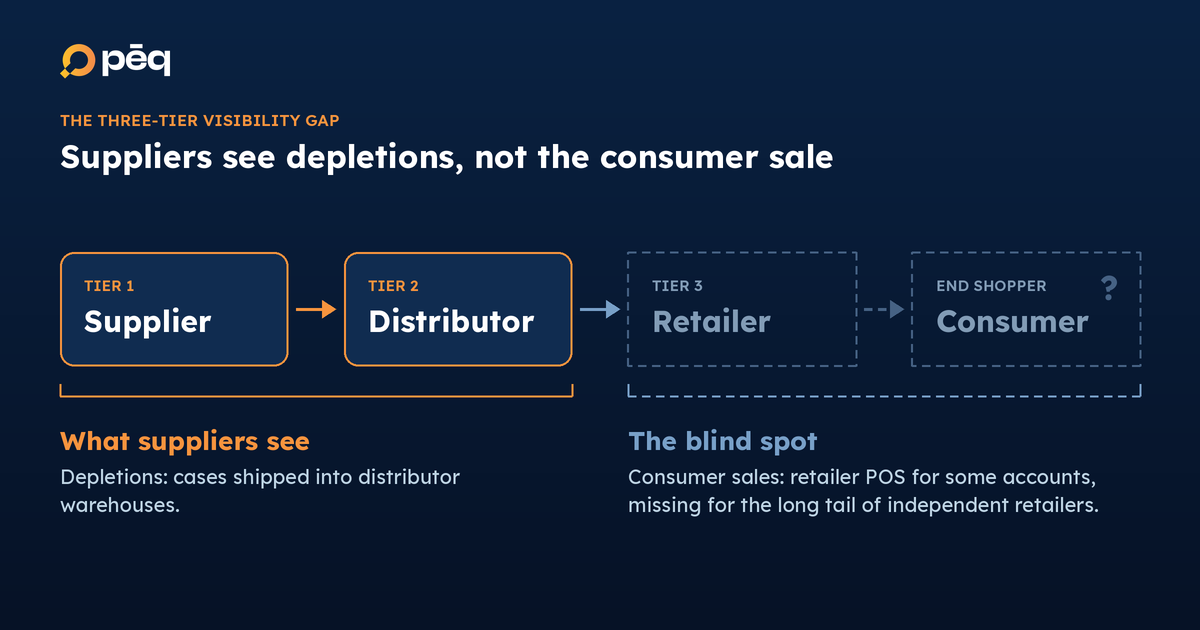
Three-tier visibility gap. Since suppliers sell to distributors, what they reliably see is depletions, not the consumer sale. Retailer POS is available for some accounts and missing for many others, and because so much volume is sold through the long tail of independent retailers, sales data is not widely available.
The biggest checks go to the hardest-to-measure tactics. Sampling, experiential, sponsorships, affiliations, events, OOH, and social are core to how this category builds brands, and they rarely get measured against actual sales.
Trade and field marketing run on faith and tradition. Local marketing funds, displays, rebates and TPRs represent enormous spend, yet most suppliers can’t say what a given dollar delivered.
Traditional MMMs arrive too late. A readout once or twice a year is a post-mortem. It can’t help you move dollars while the season is still being won. When consumer behavior is changing this dramatically, knowing what worked last year is meaningless.
December is when bad metrics look their best.
Here’s the uncomfortable truth about the holidays: a lot of that volume was coming anyway. Gifting, hosting and the year-end stock-up lift baseline demand for nearly every spirits and wine brand on the shelf.
Attributed ROAS doesn’t know that. It credits marketing for sales that would have happened without it, so in December almost everything looks like it’s working. That’s how budgets get renewed for tactics that never moved an incremental case.
Traditional MMMs have the opposite problem. The math may be closer, but the readout lands next spring, after the holiday dollars are spent and the 2027 plan is locked. And this year’s consumer is moving fast. Shoppers bought a record number of tequila bottles over the past year, yet average spend per bottle fell nearly 15% in two years as they traded into smaller sizes and cheaper brands (The Tequila Report). A model calibrated on last year’s behavior is describing a shopper who no longer exists.
And when Finance asks Marketing to justify investment, neither one gives a defensible number.
Sit in the seat of a global spirits supplier.
Imagine you run marketing for a major spirits portfolio heading into Thanksgiving week. Holiday media is in-flight, gift packs are on display, sampling teams are in stores, a football sponsorship is live, and trade dollars are flowing through distributors in dozens of states. What do you actually need from measurement?
Incremental sales, not attributed sales. What did each tactic generate above the baseline sales the holidays would have delivered anyway?
Consumer takeaway, not just shipments. Depletions tell you what moved into a distributor’s warehouse. You need to know what actually left the shelf, by class of trade, before holiday loading obscures the picture in January. Wholesale inventory remains well above historical norms, according to SipSource.
One framework for every dollar. Media, sampling, sponsorships, displays, TPRs, and field programs evaluated against the same incremental standard, so a bar activation and a retail media buy can be compared on equal terms.
A full portfolio view. Is the RTD line growing the franchise or cannibalizing the 750ml business? Is a holiday TPR on the flagship pulling shoppers away from your premium labels?
A plan for the next dollar. Understand where each tactic hits diminishing returns, so you can pull back on saturated investments and scale what’s still working.
Answers while there’s still time to act. In-flight insights that allow you to reallocate dollars before December 31, rather than waiting for a post-mortem in April.
Numbers Finance can stand behind. Results that reconcile with the sales the business actually sees, supported by transparent methodologies and confidence intervals.
That’s the bar. But most measurement in the category today doesn’t clear it.
What this holiday season can teach you about 2027.
Thanksgiving marks the start of the most consequential sales stretch of the year for many adult beverage brands. And with the industry looking for signs of a sustained recovery, SipSource analysts suggest that holiday 2026 performance could be a strong indicator of what lies ahead in 2027 (WSWA SipSource).
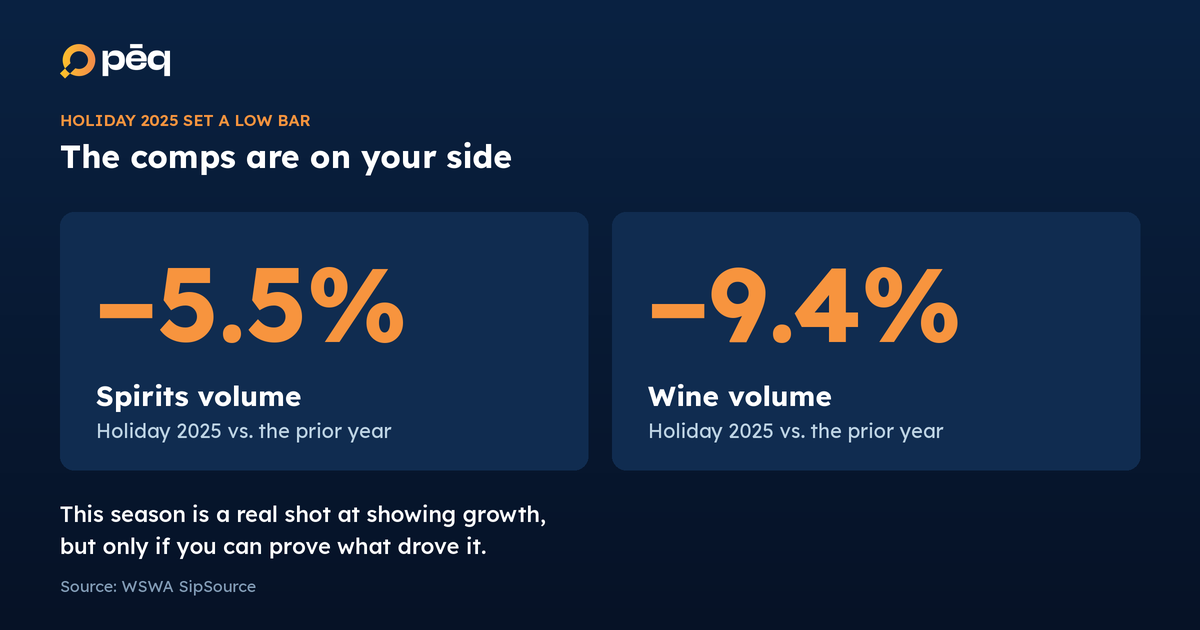
The comps are on your side. Holiday 2025 was rough, with spirits volume down 5.5% and wine down 9.4%. This season is a real shot at showing growth, but only if you can prove what drove it.
The next six weeks of in-market activity can answer the questions that should shape every 2027 plan:
– Did holiday sampling and in-store events lift sales in those stores, or just pour samples?
– Were TPRs and gift-pack displays incremental, or did they discount cases that would have sold at full price?
– Are smaller formats and RTDs bringing in new buyers, or trading down your core 750s?
– Which sponsorships and experiential programs actually moved cases in the markets where they ran?
– Which markets and classes of trade responded to investment, and which didn’t?
– Where did each tactic stop paying back?
Brands that measure now can still shift dollars before the year closes and walk into 2027 planning with evidence instead of last year’s budget. Those that wait risk making another year’s worth of investment decisions based on what worked in a market that no longer exists.
Make marketing the line item nobody wants to cut.
In a category this tight, the marketing teams that keep their budgets will be the ones that can show, tactic by tactic, what they added to the business. Not impressions. Not ROAS. Incremental cases.
That’s the gap we built Pēq to close: one consistent, always-on read of every marketing dollar, digital and non-digital, measured against real retail sales and depletions, built for how adult bev actually goes to market.
If you’re an adult bev supplier who wants to make this holiday season count, I’d love to show you what we’re seeing. Reach out at cristina@peq.ai or click here to grab time on my calendar. 🙂
Editorial sources