

The Real-World Renaissance: Rethinking What Makes Advertising Perform
 By Ben Flaccus, Chief Growth Officer
As brands invest in physical-world advertising, a consistent approach to incrementality is challenging long-held assumptions about which marketing channels drive measurable sales.
For years, the advertising industry has divided the media landscape into two broad categories: brand building and performance marketing.
Search, social, and other digital channels have dominated the performance conversation, supported by sophisticated targeting, attribution, and conversion tracking. Meanwhile, out-of-home advertising, in-store media, experiential activations, and product sampling have traditionally been evaluated through reach, engagement, awareness, and other measures of consumer interaction.
But how much of that distinction reflects actual sales performance, and how much reflects our historical ability to measure it?
As investment in physical-world advertising accelerates, that question is becoming increasingly important.
The real-world renaissance.
Advertising is expanding into more of the environments where consumers live, shop, work, and spend their time.
Digital screens are transforming retail stores, transit systems, gyms, and entertainment venues into increasingly sophisticated media environments. Brands are investing in experiential activations that create direct consumer connections, while product sampling and demonstrations bring brands closer to the moment of purchase.
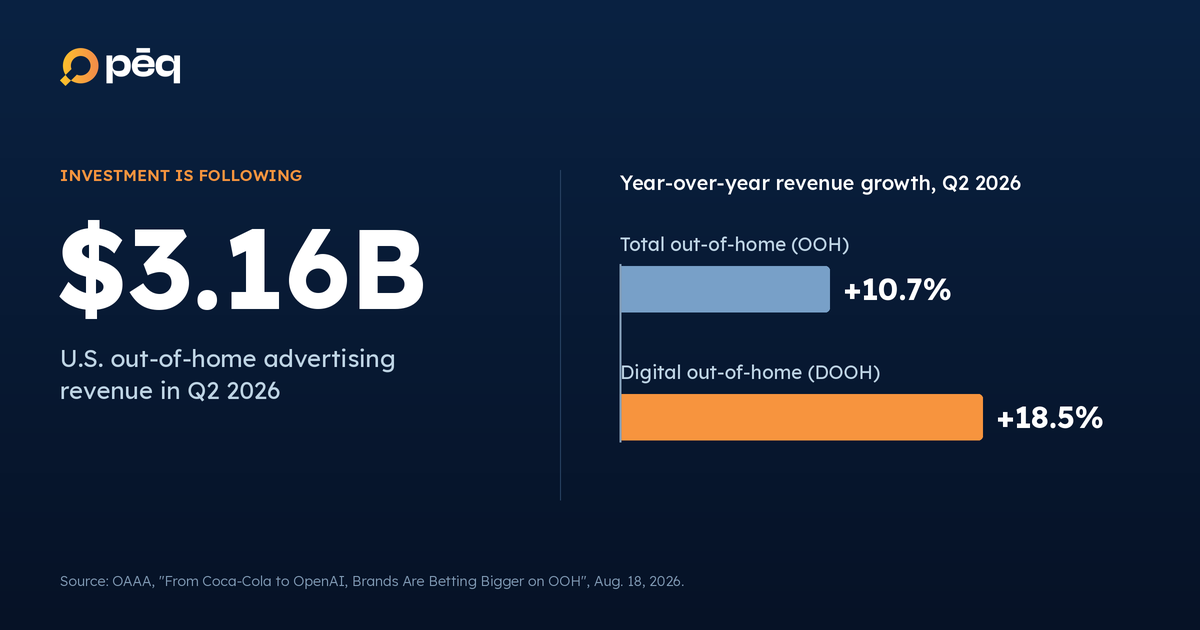
Investment is following. According to the Out of Home Advertising Association of America (OAAA), U.S. out-of-home advertising revenue grew 10.7% year over year in the second quarter of 2026, reaching $3.16 billion. Digital out-of-home (DOOH) grew even faster, increasing 18.5% over the same period [1].
Within retail media, the opportunity is particularly striking. EMARKETER forecasts that U.S. in-store retail media advertising spending will grow 33.1% in 2026 [2]. Yet in-store accounted for just 3.3% of non-Amazon U.S. retail media advertising spending in 2025, despite more than 80% of U.S. retail sales still taking place in physical stores [3].
The imbalance reflects how retail media developed. Networks built their advertising businesses around ecommerce, where impressions, clicks, and purchases could be connected more readily. Physical stores offer enormous consumer reach and proximity to purchase, but translating those advantages into measurable advertising performance has historically been more difficult.
The gap also reflects practical constraints, including inventory availability, infrastructure costs, and organizational complexity.
In a March 2026 report, EMARKETER identified measurement limitations, fragmented infrastructure, and organizational challenges among the barriers to scaling in-store retail media investment [4].
The same measurement challenge extends beyond retail stores. Experiential marketing and sampling programs create direct interactions with consumers, often at moments of discovery and trial. DOOH reaches audiences throughout their daily routines. Each offers distinctive opportunities to influence purchase behavior, but their sales contributions have been difficult to evaluate consistently.
As these channels attract greater investment, marketers need a more comparable understanding of performance.
Have we confused measurability with performance?
The rise of digital performance marketing was supported by an unprecedented ability to track consumer interactions.
Marketers could connect impressions to clicks, clicks to conversions, and conversions to attributed revenue. Channels that offered this visibility became central to performance-oriented media planning.
Physical-world channels faced a different challenge. How do you attribute a supermarket purchase to a digital screen in the aisle? How do you connect a product sample distributed at an event to subsequent retail sales? What is the sales contribution of an experiential activation or a digital billboard?
Historically, these questions were difficult to answer consistently. Marketers therefore relied on the measures they could observe: impressions, estimated reach, samples distributed, attendance, and engagement.
Over time, the industry’s definition of performance marketing became shaped as much by what could be measured as by what actually drove sales.
The channels that were easiest to attribute were not necessarily the channels generating the greatest incremental impact.
That distinction matters when brands decide where to invest their next marketing dollar.
A common standard changes the conversation.
Advances in sales-based incrementality measurement are creating opportunities to evaluate a much broader range of marketing investments against consistent commercial outcomes.
Using observed retail sales data and rigorous analytical methodologies, marketers can evaluate the incremental sales generated by campaigns across DOOH, in-store media, experiential marketing, sampling, and traditional digital channels.
This approach can work without linking an individual advertising exposure to an individual shopper’s purchase. Carefully designed test-and-control methodologies can estimate the incremental sales attributable to a campaign by comparing observed results with a credible estimate of what would have happened without the investment.
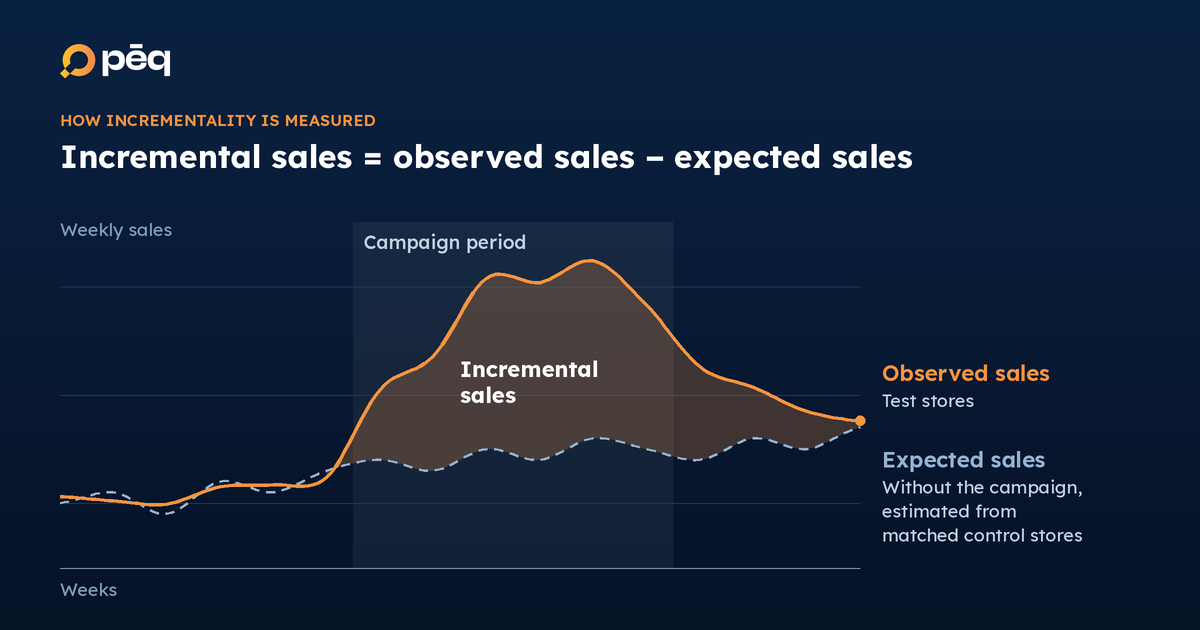
The result is a more consistent framework for evaluating performance, using incremental sales and incremental return on ad spend (iROAS). Comparing results responsibly still requires attention to campaign objectives, scope, methodology, and uncertainty.
For a sampling company, that means demonstrating the additional retail sales generated by product trial. For in-store media, it means measuring sales impact beyond impression delivery. For a DOOH or experiential partner, it creates the opportunity to demonstrate commercial outcomes in terms that brands already use to evaluate digital investment.
A wider range of channels can now be accountable for incremental growth.
Rethinking the performance media mix.
For channels traditionally associated with brand awareness, consistent incrementality measurement creates an opportunity to demonstrate sales impact and compete for performance-oriented budgets. For brands, it opens the door to better informed investment decisions across the entire marketing mix.
It also raises important questions. Are certain channels generating more incremental sales than their traditional metrics suggest? Are some investments receiving disproportionate credit because their attribution capabilities are more sophisticated? How might media plans change if marketers compared investments using a consistent standard of incremental sales and iROAS?
Those questions deserve to be answered with evidence. No channel should receive a performance advantage simply because its attribution is easier, and no channel should be assumed effective without measuring its contribution.
As physical-world advertising continues to evolve, marketers have an opportunity to reconsider long-standing assumptions about what qualifies as performance marketing. The ability to demonstrate incremental sales should extend across the marketing mix, regardless of where an advertisement appears or how consumers encounter it.
Everything is changing. Our definition of performance needs to keep up.
EDITORIAL SOURCES
[1] OAAA. “From Coca-Cola to OpenAI, Brands Are Betting Bigger on OOH.” August 18, 2026. Open source
[2] EMARKETER. “In-store experience becomes retail’s pressure valve in 2026.” (Citing its December 2025 forecast.) Open source
[3] EMARKETER. “FAQ on in-store retail media: Closing the gap between demand and execution.” June 26, 2026. Open source
[4] EMARKETER. “The Structural Constraints Limiting In-Store Retail Media.” March 2026. Open source
Review note: The 3.3% figure excludes Amazon from the retail media denominator. The 33.1% figure is a forecast, not a reported full-year result.