
The Difference Between Measuring Search Performance and Improving It: Lessons From Walmart Connect +47% iROAS Result
October 29, 2026
What if the most valuable insight from your retail media measurement isn’t how well your campaign performed, but what you should do differently next time?
That’s the question at the heart of a new Walmart Connect case study, highlighting how Pēq helped a premium sports drink brand understand the incremental sales impact of its Sponsored Products campaigns.
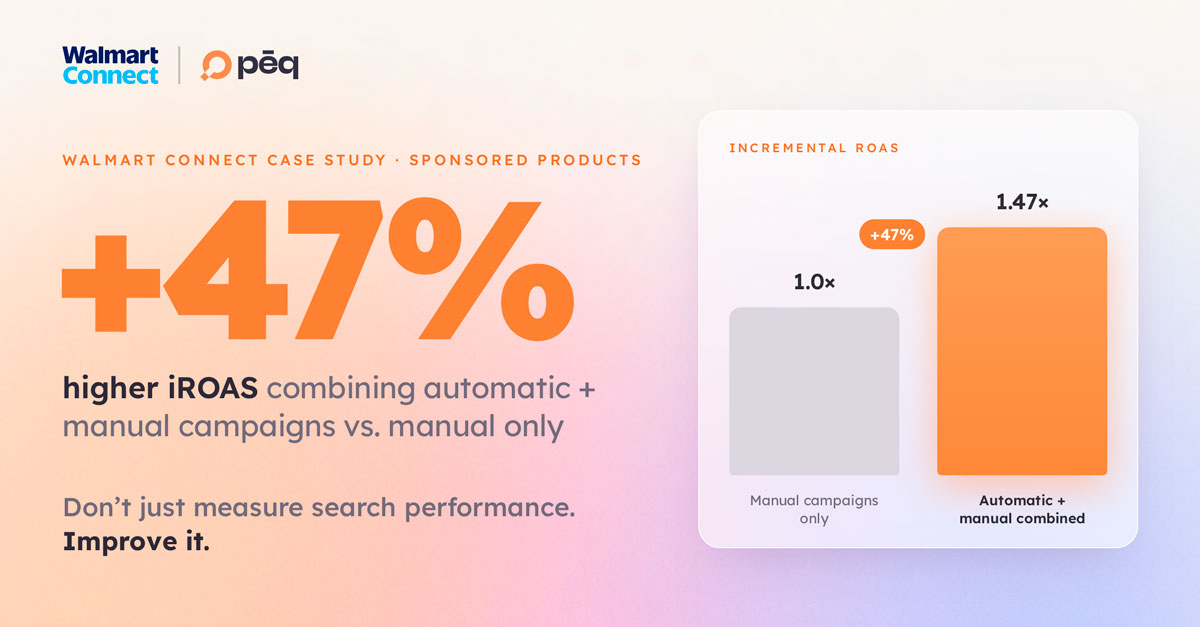
The headline result was compelling: a combined automatic and manual campaign strategy delivered 47% higher incremental return on ad spend (iROAS) than manual campaigns alone.
But beyond the result itself is an important lesson for retail media advertisers: when you can measure what your advertising actually contributes to sales, you can make better decisions about where to invest.
And that’s where measurement becomes a driver of growth, not just a record of performance.
The problem with measuring only attributed sales.
Retail media has a tremendous advantage: the ability to connect advertising activity to actual purchases.
But there’s a meaningful difference between a sale that can be attributed to an advertisement and a sale that happened because of that advertisement.
Consider a shopper who already intends to purchase your product. They search for it, see a sponsored listing, click, and buy.
Traditional attribution may give the advertisement credit for that sale. But would the shopper have purchased anyway?
This distinction matters enormously when deciding where to allocate a marketing budget.
Attributed ROAS tells you which sales were associated with advertising. Incremental ROAS helps you understand which additional sales your advertising generated.
Understanding that difference allows advertisers to identify investments that are driving genuinely incremental growth, rather than simply capturing existing demand.
The challenge: finding incremental growth in a competitive category.
A premium sports drink brand faced a familiar challenge: competing for shopper attention in a category dominated by well-established players.
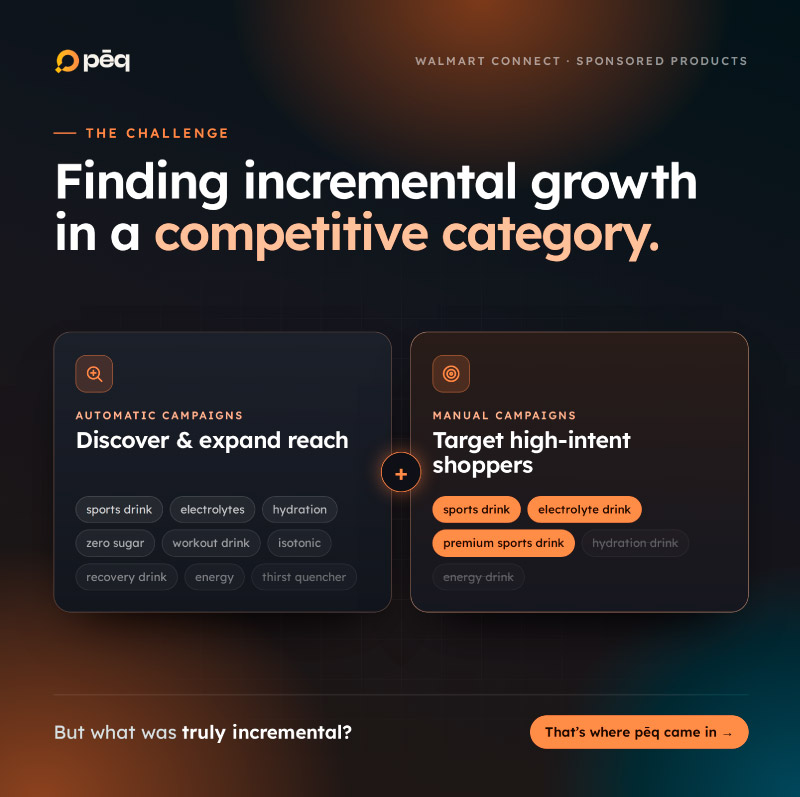
The brand worked with Walmart Connect to increase visibility, drive sales growth, and reach new customers. Its Sponsored Products strategy combined two approaches:
- Automatic campaigns helped expand reach and discover high-performing search terms.
- Manual campaigns targeted relevant category keywords to reach shoppers at high-intent moments.
Together, these approaches were designed to balance discovery, precision, and efficiency.
But the advertiser needed more than conventional campaign reporting. It wanted to understand the incremental sales impact of its media investment and use that information to improve performance.
That’s where Pēq came in.
What Pēq brought to the equation.
As a Tech Partner in the Walmart Connect Partner Network, Pēq provided independent incrementality measurement to help evaluate campaign performance and identify optimization opportunities.
The objective wasn’t simply to determine whether campaigns were generating sales. It was to better understand how effectively different advertising strategies contributed to incremental sales growth.
Pēq’s measurement brought three important capabilities to the campaign:
- Independent validation of sales impact
By measuring incremental performance, Pēq helped the advertiser look beyond attributed conversions and understand the additional sales generated by its advertising.
- A consistent basis for comparing strategies
When different campaign approaches are evaluated using the same incremental performance metric, advertisers gain a clearer picture of their relative effectiveness.
- Insights that can inform investment decisions
Identifying differences in incremental performance creates opportunities to refine campaign strategies, improve budget allocation, and pursue stronger returns.
This is the distinction between measurement that simply documents performance and measurement that helps improve it.
The result: 47% higher incremental return.
Across the April 23 to September 30, 2025 campaign period, Pēq’s analysis found that the combined automatic and manual Sponsored Products approach delivered 47% higher iROAS than manual campaigns alone.
The finding reinforced Walmart Connect’s strategy of combining automatic and manual campaigns to improve performance.
But it also demonstrated why independent incrementality measurement matters.
The advertiser wasn’t limited to knowing that its campaigns generated attributed sales. It had a clearer view of which strategy delivered stronger incremental returns.
That insight can inform how future campaigns are structured, how budgets are allocated, and how advertising strategies evolve over time.
The value wasn’t just the 47% performance difference. It was the ability to identify that difference and use it to guide smarter investment decisions.

What retail media advertisers should take away.
There are several lessons here that extend well beyond Sponsored Products or any individual retail media network.
Measure incremental outcomes, not just attributed performance
Attribution remains useful for understanding shopper interactions and campaign activity. But incremental sales and iROAS offer a different, essential perspective on the business impact of advertising.
Compare investments using consistent measures
Different tactics and campaign strategies serve different objectives. Understanding their relative contribution to incremental growth helps advertisers make more informed decisions about the mix.
Make optimization part of the measurement strategy
Measurement shouldn’t end with a post-campaign report.
The greater opportunity is to use incremental performance insights to continuously inform planning, investment allocation, and optimization.
Build a repeatable learning process
Each campaign should help make the next one more effective.
When independent measurement becomes a consistent part of the investment process, advertisers can turn individual campaign results into a growing body of actionable intelligence.
From proving performance to improving it.
For too long, much of the advertising measurement conversation has centered on proving that marketing worked.
That’s necessary, but it’s not enough.
At Pēq, we believe the greater opportunity is to help advertisers make better investment decisions before, during, and after campaigns.
That means connecting independent sales incrementality measurement with forecasting, planning, and optimization to create a continuous cycle of learning and performance improvement.
The Walmart Connect case study is a compelling example of that philosophy in action.
A 47% improvement in iROAS is a result worth celebrating.
But the bigger opportunity is what happens when advertisers can consistently identify those kinds of opportunities across their investments.
Because the most valuable measurement doesn’t just tell you what worked. It helps you decide what to do next.
Read the full case study on Walmart Connect